Sidney--who I wrote about earlier as a master of
creative responses--has been accepted to the Art
Institute of Chicago! So happy for her!
Tuesday, January 21, 2020


Sunday, January 5, 2020
As I begin planning for a new semester, I am continuing to reflect on and theorize how students create their own expressions from their education. I witnessed so many creative responses from students at the end of last semester.
One student wrote about Logic's album cover Everybody and suggested that it reminded her of the School of Athens, though others thought it was more like The Last Supper. She says, "The following is Logic's Everybody album cover. The only reason The School of Athens makes me think of this album cover is because of the overall balance and the vibrant colors of everyone's clothing contrasting with the neutral tones of the building on either side. Also, one thing I didn't know about this album cover is that it is actually a painting, I always thought it was an image someone had created in a computer program. If anyone is interested, I included a website that shows who everyone is on the album cover.
These are graphic design students, so they are interested in the art work on album covers. For their sake, I'm going to post this obituary of an iconic graphic designer of album covers who died recently.
I am looking forward to learning more from students this semester! Here is one many interesting posts from Austin, a mathematics major.

One student wrote about Logic's album cover Everybody and suggested that it reminded her of the School of Athens, though others thought it was more like The Last Supper. She says, "The following is Logic's Everybody album cover. The only reason The School of Athens makes me think of this album cover is because of the overall balance and the vibrant colors of everyone's clothing contrasting with the neutral tones of the building on either side. Also, one thing I didn't know about this album cover is that it is actually a painting, I always thought it was an image someone had created in a computer program. If anyone is interested, I included a website that shows who everyone is on the album cover.
These are graphic design students, so they are interested in the art work on album covers. For their sake, I'm going to post this obituary of an iconic graphic designer of album covers who died recently.
I am looking forward to learning more from students this semester! Here is one many interesting posts from Austin, a mathematics major.
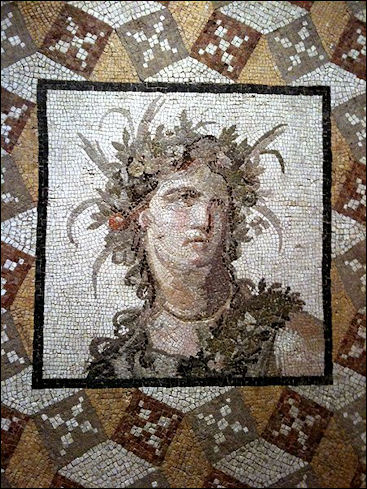
One of the most interesting topics discussed last week was
Roman mosaics. Mosaics are patterns created
by organized hard materials of stone, glass, etc. These mosaics can create stunning visuals
like the mosaic below.
These kind of remind me of fractals. Fractals are geometric figures created by
taking a simple shape, like a triangle, and repeating it whilst shrinking the shape
infinitely. While fractals are mostly computer generated, they can also be found in nature, although their pattern is
not infinite. Some examples of fractals
in nature include snowflakes, DNA, algae, trees, and more.
Below is one of the most famous fractals called the
Mandelbrot Set. This is an example of an
infinitely repeating fractal. If you
scroll down on this website, you will find an interactive image of the Mandelbrot
Set where you can zoom in and witness its beauty.
Friday, October 4, 2019
The Latin Creare: Creative Responses in Education Regardless of Economics
Anxiety, silence, hustle, and gamesmanship--so much goes on in college classes so it is stunning when there is also joy. At the end of every General Education humanities course, my classes take a group final where I offer a question and they discuss it without me and a student's name is chosen from a hat to answer for the class. It is always a compelling experience. It breaks down the I-just-care-about-my-grade college experience. Last year I asked, "How is it that we created so much joy in this class together?"
I am interested in joy through the struggle of being a student, but I want to share students' experiences in making a creative education for themselves, those who make creative responses to school activities even as they have jobs and full lives outside of college. I hope to share their stories here.
One way students make
their own meaning is through connections to their “outside” of school discourse
communities (as Gerald Graff might say in "Hidden Intellectualism.") For example, Sidney is in
my Humanities 101 class on ancient cultures.
She works at Herbs Etc. in Mt. Pleasant.
Here is a bit of her response to our class (used with her permission) in week two where she tells
us about her job and Egyptian oils on the online forum:
I wanted to bring this to light
because there are some very specific blends that have been named after several
Gods and Goddesses. One of which is the essential oil blend Tjet. I know what you’re
thinking. What on Earth does this have to do with this week's topic? Let me
explain. In Ancient Egypt there is a Goddess known by the name of Isis (not
that Isis)…
Oh struggling but joyful students out there, how do you connect your job or hobbies to your college learning?

Monday, November 26, 2018
"I spent much of my childhood listening to the sound of striving." This is the first sentence of the first chapter of Michelle Obama's Becoming. I love it. I think the first couple chapters of her experiences in kindergarten and early elementary would be so interesting for pre-service teachers.
I also like the ways she describes the way she learns "college knowledge" and resilience.
I was learning all the time now...in the obvious academic ways, holding my own in classes...how to write efficiently, how to think critically. I'd inadvertently signed up for a 300-level theology class as a freshman and l floundered my way through, ultimately salvaging my grade with an eleventh-hour, leave-it-all-on-the-field effort on the final paper. It wasn't pretty, but I found it encouraging in the end, proof that I could work my way out of just about any hole. (78)
Later, she encourages students to plan ahead, start way ahead of deadlines. Of course, the autobiography is an amazing inside perspective on campaigning, on being an ambassador as First Lady, on living on the South Side and on being a devoted mom while working for nonprofits. I've imagined talking with Michelle Obama in my living room, and now at least I got to hear her voice and story in my living room!
I also like the ways she describes the way she learns "college knowledge" and resilience.
I was learning all the time now...in the obvious academic ways, holding my own in classes...how to write efficiently, how to think critically. I'd inadvertently signed up for a 300-level theology class as a freshman and l floundered my way through, ultimately salvaging my grade with an eleventh-hour, leave-it-all-on-the-field effort on the final paper. It wasn't pretty, but I found it encouraging in the end, proof that I could work my way out of just about any hole. (78)
Later, she encourages students to plan ahead, start way ahead of deadlines. Of course, the autobiography is an amazing inside perspective on campaigning, on being an ambassador as First Lady, on living on the South Side and on being a devoted mom while working for nonprofits. I've imagined talking with Michelle Obama in my living room, and now at least I got to hear her voice and story in my living room!
Monday, November 19, 2018
I like stories about science. I’ve enjoyed biographies about Copernicus and
Einstein. Recently, I’ve liked reading
about 19th century female scholars in science in Elizabeth Gilbert’s
The Signature of All Things about a
character who studies mosses and corresponds with Darwin and Barbara
Kingsolver’s Unsheltered about a real
biologist who corresponded with Darwin.
In Kingsolver’s novel there is a character who is a science
teacher—Thatcher Greenwood. Though born
in poverty without a mother and an alcoholic, abusive father, he helps doctors
in the Civil War and one of them sends him to Harvard afterwards. He ends up leaving Boston to a small town
that is run by “moralists.” He wants to
take his students—mostly girls—into the fields and woods for data collection
but is not allowed to. He shares the
history of science, introducing Darwin’s “descent with modification.” Eventually, he is forced to speak at a public
debate called “Darwin vs. Decency.” The local media is all over it. Though he carefully and patiently debates the principal, he loses and
eventually loses his job.
Dana Goldstein starts The Teacher Wars: A History of America’s Most Embattled
Profession with the claim that public school teaching has become the most
scrutinized profession. I think it is
good for us to remember the very old debates about “content” and also about “pedagogy.” So courageous.
Here’s a couple of great lines:
“Thatcher himself in daily contest with the baby Jesus as he
tried to hold their attention to the so-called imponderables of physics: light, heat, magnetism, conservation of
energy. He was losing, to the more
ponderable Virgin birth. His fellow
teachers advised against trying.”
(254-255)
Sunday, November 11, 2018
Time
It is time to dust off this blog. The grieving has gone on long enough. Time has gone so fast. It is November, so it is overcast. Here is the beginning of Moby Dick. I share it with students to help them know some complex sentences, some parallel structure. Now is the time that students feel overwhelmed and gloomy. I hope they might feel connected to others. For the first time, however, I felt uneasy about the final line. My "sea," Lake Michigan, feels a long way off, so my substitute is pen and paper, and I hope that along with paint, brushes, crayons, keyboarding, strumming...it is others' substitute as well.

Whenever
I find myself growing grim about the mouth; whenever it is a damp, drizzly
November in my soul; whenever I find myself involuntarily pausing before coffin
warehouses, and bringing up the rear of every funeral I meet; and especially
whenever my hypos get such an upper hand of me, that it requires a strong moral
principle to prevent me from deliberately stepping into the street, and
methodically knocking people’s hats off—then, I account it high time to get to
sea as soon as I can. This is my
substitute for pistol and ball.
Ishmael, Moby Dick by Herman
Melville

a nest made out of this
and that
Sunday, May 12, 2013
Mother's Day Grief and Gratefulness

In
Gratitude for Mira
In gratitude, I thank my mother
for the pain she alone
felt, in a linoleum-floored hospital bed
as she labored to deliver me into this world,
without many words of English, as a
Polish-speaking
nurse came to interpret the foreign feelings
and words.
In gratitude, I thank my Mama
for going through this labor again
to bring me home the gift of my lovely sister
Eva,
my partner in flower-watering and care-giving;
the gift of my brother Henio, who I sent her
forth
to deliver in my innocence and to whom I can
wholely attribute
my hero-complex—as I saved him from his driving
a rolling Oldsmobile
down the driveway to the ditch,
as I saved his shoe from going down a flooded
creek and
thus from the wrath of our mother, and as I
saved him
from the alone encounter with the kindergarten
teacher in a new school—
and the gift of my sister Jakubina,
whose beauty and gentle spirit,
reflects, as Maria, one of our many cousins who
loved Mama, says,
of Aunt Myra herself.
In gratitude, I thank my Mama
for sharing meal after meal with me
from her breast; from the high chair where we
learned
of President Kennedy’s death
and cried together;
from the many vegetables she grew
so that we could grow
healthy and strong;
from the chickens, pigs and steers
she fed and raised;
from the milk she squeezed out of the teats in
the cold barn.
In gratitude, I thank her
for each chicken’s head
she felled with her axe on the tree stump,
telling me later that it was a horrible
business,
but she did it for us—for our strength, for our
education,
just as her mother, Babcia, sold eggs in Poland
for her boarding school
education to be a teacher, taking the train to
another town.
I thank her
for each chicken feather
she plucked—each and every one—thousands
of them, I give thanks.
And for waking up early and for sending me off
to college so that I could come to her
profession as well.
In gratitude, I thank Mum, the Baba of my
children,
for her pain when my own labor came,
for taking care of her Rysiu for five weekends
in a row,
so that I could do my graduate studies.
I thank her for caring for him and Franiu while
I traveled
to conferences and adventures
and for the cards we have from them still
because of the craft time she shared with them.
I thank her for the many sweaters, gloves, and
hats
she made
for them and me,
and for the books she loved and
we loved together.
In gratitude, I thank Mum
for her love of flowers and the outdoors—
because as my dear husband, who she was
grateful for, says to me:
“You have the expanse of the farm in your
soul.”
She was also deeply grateful, as I am, for the
uniquely-suited and deeply-loyal
husbands of my sisters, Patrick and Daniel, and
their love and care for their flowers.
She let me grow and care for a patch of flowers
on the farm,
and at the nursing homes, so that my own garden
became a daily comfort
as she was sick, as she died. And as I pulled dead marigolds off their
stems,
my head down in the orange and gold of grief, I
saw the Babcias and Stryankas running
towards her in joy with their arms open wide,
“Mira! Mira!”---and of course crying.
In gratitude, I thank Mum
for staying on this earth until I got to know
her on a deep level,
past the childhood ungratefulness, passed the
teenage angst and selfishness,
past the busy parenthood and career building.
I got to experience her unconditional love late,
beyond the childish love where I thought she
was just
demanding and annoying.
And after her truly annoying initial dealings
with doctors,
to a place of accepting their attempts at help.
She waited, she held on,
through despair and pain,
through the humility of others taking care of
her
in a linoleum-floored hospital bed.
She let me lose my temper, demanding better
care.
She let me have her sit in her wheelchair in
the lobby in her private pain,
so that it would shame the sluggish staff to
quickly move.
She let me love every chin hair, fingernail,
permed curl,
She let me love her stroke-curved toe, her
hairy shins, the blackened thin-skin patches,
the crooked arm, the sharp blue eyes and
tongue, the beautiful skin,
her suffering soul.
She patiently let me put her to bed, not
knowing that I would be the last person
to do so.
Although she often said, “ouch!” she didn’t then.
And as Eve and I wept about her life of
suffering, during what we didn’t know were her
final moments, and came to realize that her
suffering gave her such strength for
others—for the many nurse’s aides, friends with
children, for us—she then took her last
breath to remind us that suffering is not
without heart, without love for others.
As children, she took care of our bodies and
souls,
As adults, we took care of her body, and she
took care of our spirits.
Wikipedia, our communal knowledge source, says
“Mira” is a giant red star,
that it is a “brightest periodic variable in
the sky that is not visible to the naked eye
for part of its cycle” and that there is a disc
that is “being accreted from material
in the
solar wind from Mira and could eventually form new planets.”
In gratitude, I cherish that I am a part of her
constellation,
I am grateful that we will be able to continue
to form new readings
from our gratitude from the deep and rich
source,
of light and being and life.
Subscribe to:
Posts (Atom)