Thursday, June 25, 2020

Letters on Covid-19 Re-engagement: Rhetorical Analysis Possibilities


Due to the need for clear and caring messaging during re-engagement within the Covid-19 pandemic, many service providers and businesses have been compelled to write letters to their clients, customers, or community members.  Certainly, these notes could be included on the front of websites, but I find it interesting that I have received so many letters in the mail.  Perhaps I belong to or use services where a letter was needed since they did not have email addresses or had folks who did not have one.  Mail--even these form letters--have become more appreciated in the past few months because many people were sequestered in their homes.

These communications are meant to alleviate fear about returning to services.  My first decision about whether to return to a service was to go to get my yearly mammogram in May.  The radiography department is within the local hospital.  I did not get a letter or any information about what they would be doing to make me safe or feel safe.  I had to call myself, and they told me what I would be doing to make others safe.  

These letters, on the other hand, included information about what “we” were going to do, in addition to what “you” would be required to or could do.  They were each carefully crafted.  Thus, I believe they offer an opportunity for faculty to help students note the rhetorical urgency of these letters and even suggest the importance of learning to write with rhetorical sensitivity to students who may not think they will have this need in their future workspaces.  I will analyze three letters--especially format, greeting, and point of view--as a model for rhetorical analysis for composition or humanities courses in the early fall.  And I will try to use a rhetorical strategy myself--writing as briefly as I can.

These are the three that I am choosing to analyze:

  • From a dentist, on colorful, business-designed stationery including bullet points
  • From a church, two full white pages with some bullets in which a participant has to answer “yes”
  • From a massage therapist, full white two pages with numbered guidelines and bullets of suggestion and a graphic at the end with two hands held together with roots coming out

The textual conventions of bullets or numbers work to make the message clear and easy to read.  The letter from the dentist is crammed together with no spaces between lines, clearly attempting at making a one page letter.

All three use a formal letter writing strategy in a “block” format that includes their address at the top.  The greeting is carefully considered to create a caring tone:    “Dear Patient,” from the dentist; “Dear Friends of Christ,” from the church; and “To my amazing clients,” from the massage therapist.  The first line from the dentist and the church focuses on the care in safety and wellness.  Surprisingly, the massage therapist’s letter begins with her feelings and connecting them to others:  “waking every morning to a new episode of the twilight zone...challenging in completely new and sometimes scary ways...Transitioning our…’new normal’...a steady decline...makes it feel like the sun is shining once again.  I feel you.  I am right here with you.  We are all in this together.”  This letter shares raw feelings as a way of connecting to the clients.  

All of them have a “we” voice at some point but then shift to a “you” point of view. The dentist begins:  “We have been thinking about you and hope that you and your family are safe and healthy.  Everyone has been through a lot.”  This sentiment is in all of the letters, a reassuring acknowledgement of community experience.  Then the letter shifts back and forth between what “we” will do (e.g. wear masks, allow more times between appointments) and what “you” will do (e.g. come alone if possible, wear masks).  Though the letter from the church is also written by one person, it quickly shifts from “I” to “we” (we have decided, we have limited space, we need volunteers) and then moves to what “you” will be required to do.  

The attempt to modify fear is a purpose with comments like “[we have] extended the dispensation for the Sunday obligation to all the faithful until August 30th.  No one should feel obligated to attend Mass, nor should anyone risk the health and safety of another person to attend.”  Likewise, the letter from the massage therapist discusses what “we” will do and then shifts to what “you can do to help.”  The letter also includes qualifiers:  “Is it perfect? No. Can we guarantee 100% protection from pathogens?  Unfortunately no.”  Somehow admitting that there is an understanding that there are still risks feels comforting.  Both the dentist and massage therapist acknowledge information from the CDC and professional organizations.  Although all of the contact information is provided in the letters, only the dentist actually offers patients to call if they have questions.

The challenge in analyzing letters in the fall might be that some students did not get letters or they threw them away.  If they can recall any of interest to them, they could ask for another letter from a service provider or business.  Some of the letters might even be included on a website.  During campaigns I use flyers that reach my door to teach rhetorical analysis, especially for school boards and other local candidates.  Although letter writing in the form of a “cover letter” is seen as a technical writing component and needs to be a part of their writing repertoire for job-focused students, analyzing letters together might help expose students to the need to consider rhetorical choices in their writing in specific and unexpected situations that we will encounter in the future.  This pandemic has given us many opportunities to connect the world to the classroom, and I believe that analyzing these timely letters is one of them.

Monday, May 25, 2020


Usually in our village there is a large ceremony at the cemetery, but because humans here are so creative, at 11 a.m. there will be taps played in procession, trumpet players lined up every 1/10 of a mile for two miles.  I’ve been reading every story phrase of the 1000 lives the NY Times gleaned from obituaries all over the country as a sample of the 100K.  I love ones like Kerry Lehman, 62, Jackson, Mich., shining light and an uplifting presence and Frances M. Pilot, 81, Wall, NJ, known as Big Mama to all who loved her; I am amazed by ones like Philip Kahn, 100, Westbury, NY, World War II veteran whose twin died in the Spanish Flu epidemic and Jerzy Glowczewski, 97, NYC, last of the WWII Polish fighter pilots; and we honor Idris Bey, 60, NYC, EMT and former Marine who rushed to the World Trade Center on 9/11 and Don Osceola, 77, Hollywood, FL, decorated Vietnam War veteran and member of the Seminole Tribe.  Humans are so varied and creative both in their lives and in their expressions to honor them.  Selah.

Tuesday, January 21, 2020

Sidney--who I wrote about earlier as a master of 
creative responses--has been accepted to the Art 
Institute of Chicago!  So happy for her!

Sunday, January 5, 2020

As I begin planning for a new semester, I am continuing to reflect on and theorize how students create their own expressions from their education.  I witnessed so many creative responses from students at the end of last semester. 

One student wrote about Logic's album cover Everybody and suggested that it reminded her of the School of Athens, though others thought it was more like The Last Supper.  She says, "The following is Logic's Everybody album cover. The only reason The School of Athens makes me think of this album cover is because of the overall balance and the vibrant colors of everyone's clothing contrasting with the neutral tones of the building on either side. Also, one thing I didn't know about this album cover is that it is actually a painting, I always thought it was an image someone had created in a computer program. If anyone is interested, I included a website that shows who everyone is on the album cover.

These are graphic design students, so they are interested in the art work on album covers.  For their sake, I'm going to post this obituary of an iconic graphic designer of album covers who died recently.

I am looking forward to learning more from students this semester! Here is one many interesting posts from Austin, a mathematics major. 

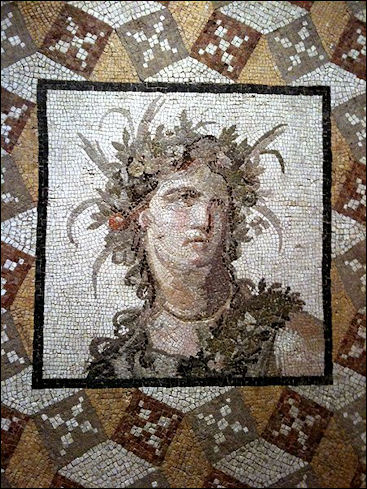
One of the most interesting topics discussed last week was Roman mosaics.  Mosaics are patterns created by organized hard materials of stone, glass, etc.  These mosaics can create stunning visuals like the mosaic below.
 Image result for roman mosaic
These kind of remind me of fractals.  Fractals are geometric figures created by taking a simple shape, like a triangle, and repeating it whilst shrinking the shape infinitely.  While fractals are mostly computer generated, they can also be found in nature, although their pattern is not infinite.  Some examples of fractals in nature include snowflakes, DNA, algae, trees, and more. 
 Image result for fractals in nature
Below is one of the most famous fractals called the Mandelbrot Set.  This is an example of an infinitely repeating fractal.  If you scroll down on this website, you will find an interactive image of the Mandelbrot Set where you can zoom in and witness its beauty.

Image result for mandelbrot set

Friday, October 4, 2019

The Latin Creare: Creative Responses in Education Regardless of Economics


Anxiety, silence, hustle, and gamesmanship--so much goes on in college classes so it is stunning when there is also joy.  At the end of every General Education humanities course, my classes take a group final where I offer a question and they discuss it without me and a student's name is chosen from a hat to answer for the class.  It is always a compelling experience.  It breaks down the I-just-care-about-my-grade college experience.  Last year I asked, "How is it that we created so much joy in this class together?"
I am interested in joy through the struggle of being a student, but I want to share students' experiences in making a creative education for themselves, those who make creative responses to school activities even as they have jobs and full lives outside of college.  I hope to share their stories here.
One way students make their own meaning is through connections to their “outside” of school discourse communities (as Gerald Graff might say in "Hidden Intellectualism.")  For example, Sidney is in my Humanities 101 class on ancient cultures.  She works at Herbs Etc. in Mt. Pleasant.  Here is a bit of her response to our class (used with her permission) in week two where she tells us about her job and Egyptian oils on the online forum:

I wanted to bring this to light because there are some very specific blends that have been named after several Gods and Goddesses. One of which is the essential oil blend Tjet. I know what you’re thinking. What on Earth does this have to do with this week's topic? Let me explain. In Ancient Egypt there is a Goddess known by the name of Isis (not that Isis)…


Oh struggling but joyful students out there,  how do you connect your job or hobbies to your college learning?

Monday, November 26, 2018

"I spent much of my childhood listening to the sound of striving."  This is the first sentence of the first chapter of Michelle Obama's Becoming.  I love it.  I think the first couple chapters of her experiences in kindergarten and early elementary would be so interesting for pre-service teachers.  

I also like the ways she describes the way she learns "college knowledge" and resilience.

I was learning all the time now...in the obvious academic ways, holding my own in classes...how to write efficiently, how to think critically.  I'd inadvertently signed up for a 300-level theology class as a freshman and l floundered my way through, ultimately salvaging my grade with an eleventh-hour, leave-it-all-on-the-field effort on the final paper.  It wasn't pretty, but I found it encouraging in the end, proof that I could work my way out of just about any hole. (78)

Later, she encourages students to plan ahead, start way ahead of deadlines.  Of course, the autobiography is an amazing inside perspective on campaigning, on being an ambassador as First Lady, on living on the South Side and on being a devoted mom while working for nonprofits.  I've imagined talking with Michelle Obama in my living room, and now at least I got to hear her voice and story in my living room!

Monday, November 19, 2018


I like stories about science.  I’ve enjoyed biographies about Copernicus and Einstein.  Recently, I’ve liked reading about 19th century female scholars in science in Elizabeth Gilbert’s The Signature of All Things about a character who studies mosses and corresponds with Darwin and Barbara Kingsolver’s Unsheltered about a real biologist who corresponded with Darwin. 

In Kingsolver’s novel there is a character who is a science teacher—Thatcher Greenwood.  Though born in poverty without a mother and an alcoholic, abusive father, he helps doctors in the Civil War and one of them sends him to Harvard afterwards.  He ends up leaving Boston to a small town that is run by “moralists.”  He wants to take his students—mostly girls—into the fields and woods for data collection but is not allowed to.  He shares the history of science, introducing Darwin’s “descent with modification.”  Eventually, he is forced to speak at a public debate called “Darwin vs. Decency.”  The local media is all over it.  Though he carefully and patiently debates the principal, he loses and eventually loses his job.

Dana Goldstein starts The Teacher Wars:  A History of America’s Most Embattled Profession with the claim that public school teaching has become the most scrutinized profession.  I think it is good for us to remember the very old debates about “content” and also about “pedagogy.”  So courageous.

Here’s a couple of great lines:
“Thatcher himself in daily contest with the baby Jesus as he tried to hold their attention to the so-called imponderables of physics:  light, heat, magnetism, conservation of energy.  He was losing, to the more ponderable Virgin birth.  His fellow teachers advised against trying.”  (254-255)

Sunday, November 11, 2018

Time

It is time to dust off this blog.  The grieving has gone on long enough.   Time has gone so fast.  It is November, so it is overcast.  Here is the beginning of Moby Dick. I share it with students to help them know some complex sentences, some parallel structure.  Now is the time that students feel overwhelmed and gloomy.  I hope they might feel connected to others.  For the first time, however, I felt uneasy about the final line.  My "sea," Lake Michigan, feels a long way off, so my substitute is pen and paper, and I hope that along with paint, brushes, crayons, keyboarding, strumming...it is others' substitute as well.


Whenever I find myself growing grim about the mouth; whenever it is a damp, drizzly November in my soul; whenever I find myself involuntarily pausing before coffin warehouses, and bringing up the rear of every funeral I meet; and especially whenever my hypos get such an upper hand of me, that it requires a strong moral principle to prevent me from deliberately stepping into the street, and methodically knocking people’s hats off—then, I account it high time to get to sea as soon as I can.  This is my substitute for pistol and ball.
                                                      Ishmael, Moby Dick by Herman Melville


                                                          a nest made out of this and that

Sunday, May 12, 2013

Mother's Day Grief and Gratefulness


In Gratitude for Mira
In gratitude, I thank my mother
for the pain she alone
felt, in a linoleum-floored hospital bed 
as she labored to deliver me into this world,
without many words of English, as a Polish-speaking
nurse came to interpret the foreign feelings and words.

In gratitude, I thank my Mama
for going through this labor again
to bring me home the gift of my lovely sister Eva,
my partner in flower-watering and care-giving;
the gift of my brother Henio, who I sent her forth
to deliver in my innocence and to whom I can wholely attribute
my hero-complex—as I saved him from his driving a rolling Oldsmobile
down the driveway to the ditch,
as I saved his shoe from going down a flooded creek and
thus from the wrath of our mother, and as I saved him
from the alone encounter with the kindergarten teacher in a new school—
and the gift of my sister Jakubina,
whose beauty and gentle spirit,
reflects, as Maria, one of our many cousins who loved Mama, says,
of Aunt Myra herself.

In gratitude, I thank my Mama
for sharing meal after meal with me
from her breast; from the high chair where we learned
of  President Kennedy’s death
and cried together;
from the many vegetables she grew
so that we could grow
healthy and strong;
from the chickens, pigs and steers
she fed and raised;
from the milk she squeezed out of the teats in the cold barn.
In gratitude, I thank her
for each chicken’s head
she felled with her axe on the tree stump,
telling me later that it was a horrible business,
but she did it for us—for our strength, for our education,
just as her mother, Babcia, sold eggs in Poland for her boarding school
education to be a teacher, taking the train to another town.
I thank her
for each chicken feather
she plucked—each and every one—thousands
of them, I give thanks.
And for waking up early and for sending me off
to college so that I could come to her profession as well.

In gratitude, I thank Mum, the Baba of my children,
for her pain when my own labor came,
for taking care of her Rysiu for five weekends in a row,
so that I could do my graduate studies.
I thank her for caring for him and Franiu while I traveled
to conferences and adventures
and for the cards we have from them still
because of the craft time she shared with them.
I thank her for the many sweaters, gloves, and hats
 she made for them and me,
and for the books she loved and
we loved together.

In gratitude, I thank Mum
for her love of flowers and the outdoors—
because as my dear husband, who she was grateful for, says to me:
“You have the expanse of the farm in your soul.”
She was also deeply grateful, as I am, for the uniquely-suited and deeply-loyal
husbands of my sisters, Patrick and Daniel, and their love and care for their flowers.
She let me grow and care for a patch of flowers on the farm,
and at the nursing homes, so that my own garden became a daily comfort
as she was sick, as she died.  And as I pulled dead marigolds off their stems,
my head down in the orange and gold of grief, I saw the Babcias and Stryankas running
towards her in joy with their arms open wide, “Mira!  Mira!”---and of course crying.

In gratitude, I thank Mum
for staying on this earth until I got to know her on a deep level,
past the childhood ungratefulness, passed the teenage angst and selfishness,
past the busy parenthood and career building.
I got to experience her unconditional love late,
beyond the childish love where I thought she was just
demanding and annoying. 
And after her truly annoying initial dealings with doctors,
to a place of accepting their attempts at help.
She waited, she held on,
through despair and pain,
through the humility of others taking care of her
in a linoleum-floored hospital bed.
She let me lose my temper, demanding better care.
She let me have her sit in her wheelchair in the lobby in her private pain,
so that it would shame the sluggish staff to quickly move.
She let me love every chin hair, fingernail, permed curl,
She let me love her stroke-curved toe, her hairy shins, the blackened thin-skin patches,
the crooked arm, the sharp blue eyes and tongue, the beautiful skin,
her suffering soul.
She patiently let me put her to bed, not knowing that I would be the last person
to do so.  Although she often said, “ouch!” she didn’t then. 
And as Eve and I wept about her life of suffering, during what we didn’t know were her
final moments, and came to realize that her suffering gave her such strength for
others—for the many nurse’s aides, friends with children, for us—she then took her last
breath to remind us that suffering is not without heart, without love for others.
As children, she took care of our bodies and souls,
As adults, we took care of her body, and she took care of our spirits.
Wikipedia, our communal knowledge source, says
“Mira” is a giant red star,
that it is a “brightest periodic variable in the sky that is not visible to the naked eye
for part of its cycle” and that there is a disc that is “being accreted from material
 in the solar wind from Mira and could eventually form new planets.”
In gratitude, I cherish that I am a part of her constellation,
I am grateful that we will be able to continue to form new readings
from our gratitude from the deep and rich source,
of light and being and life.


Monday, October 29, 2012


Poetic Times
        For nikki[i]

Elated, I drive up the highway
to class, smiling.
My students—who I don’t own,
so I don’t know why I use the possessive—
see that poetry is not just a puzzling problem to perceive
the answer,
but an experience, a transformation, a view—when
then I approach an Amish farmer, plowing
with six rugged tan horses, three in a row,
he with a hat and focused ahead,
me and my cell phone focused abroad,
with the golden, red leaves spanning the horizon,
and his dog, marching beside,
and me speeding along a one-way highway.
I get to where I’m going,
and a student who teaches me says,
“Stop and Listen, and you may be able to understand
how to free
yourself
as well.”
                                                                   Lucia Elden 17 October 2012


[i] This poem is partly in response to nikki giovanni’s 1968 poem http://sbacari.tripod.com/poetry/forsaundra.htm  and also an online class discussion, including a quote from a student’s discussion forum post in response to a quote on freedom in “Sonny’s Blues” by James Baldwin

Sunday, January 1, 2012

"Hook" for a New Year's Day


Today is as good as any to write. :)
After a semester of stats and proposal writing, plus teaching like crazy (comp and 2 online literature classes, 50 papers for every assignment but amazing traditional college students and dual enrolled students), I am done with my course work for my doctoral program. So yesterday I wrote a poem, and it felt wonderful.
It was about a visit to our humanities-based research class by MSU professor and nonfiction writer, Marcia Aldrich. As a gift to her and the class. I started with this line: "She enters the room with laughter and a bag." Often, we try to get students to create a "hook" to get readers into their writing, but I realized that sometimes you need to find a "hook" to get yourself as a writer to be engaged. This line propelled me into writing the rest of it. I want to think about this more with my students. I ended it this way: "I am left with more questions in my notes than answers: a good sign of a good presenter, of a good teacher, of a good poet. I am left with more inspiration than theory. I am left with more."

This fall I also presented at the Teaching English at the Two-Year College midwest conference, and it went really well. It was on repurposing technology in the composition class. This coming year I will have a chance to present at a couple of other conferences, which is a growth experience for sure. http://www.tycamw.org/Columbus%202011%20Conference.htm

As I look back on the year and all the amazing experiences I had in the classroom and out, I am sure that my Study Trip to Vietnam was the most life changing. I hope to have reflected on it enough by now to write about it soon. Here is me at the Temple of Literature in Hanoi.


Monday, April 18, 2011

Springtime Inspirations after a Long Winter


I am certainly inspired by my grad classes, but today I had a chance to go to a National Writing Project "continuity event"--or our local branch of it at the Chippewa River Writing Project. It was inspiring to hear second grade teachers and middle school teachers talk about using Glogster to engage their boys and girls in writing; to hear all the teachers including teacher educators share their writing about the changeable Michigan weather (both atmospheric and political); and to hear how invigorated they all are about their teaching and their own writing projects.

I was also inspired by Central Michigan University's Imagining the Fantastic conference, where artists talked about their creative process. Diane Ackerman's new book One Hundred Names for Love: A Stroke, A Marriage, and the Language of Healing is also about the creative process--her writing process and the creativity that the brain has to try to heal itself after an injury. And how we heal each other.

Today near the end of another semester, I am inspired to shift into spring.

Monday, November 1, 2010

Linguistic Diversity


My mother has a strong Polish accent, so I am not bothered as much by accents as some people are. And I so respected the way my African American and Hispanic students in Texas were able to "code switch." I am learning so much from my MSU classmates about World English and also from reading a fabulous little anthology by Smitherman and Villanueva (2003) called Language Diversity in the Classroom: From Intention to Practice. Here is a quote from Kim Brian Lovejoy:

As more teachers develop their pedagogies to accommodate diverse students and their linguistic differences, we will begin to see the kind of programmatic changes in writing programs that can have an impact on large numbers of students and create an environment for teachers to share best practices and to talk, reflectively and productively, about issues of linguistic diversity in the classroom (p. 96).

In honor of this learning in school and in "informal learning" at a wedding I attended over the weekend where I learned about Indian food and dance and marriage, I submit this photo.

Sunday, October 3, 2010

The End of a Season

Not much of a video, but a Chippewa River Writing Project friend asked me how my garden was and so I had hoped to take a picture of it and accidentally took a video of it! Last night we had a frost, so my zinnias are gone; today was the Detroit Tigers last game (thankfully they won and so they finished 500); and I had my first fire in the fireplace. The semester has settled into its routine.

I guess this is a once a season blog. I mostly blog in my mind. Is there such a thing? I think of blogging ideas on walks, while I read, when in my classes as a student or as a teacher. I had hoped to be a resource for others, and I need to pick it up!

Thursday, July 15, 2010

Now and Then


Today the BP oil "spill" has been capped. It was interesting to listen to NPR discussions about what the "spill" should be called and how BP has co-opted the Internet to influence the "informational" impact. And how the Internet is influencing our language.

Which is one reason why we have to keep reading books, I suppose--to counter this influence. But that sounds like a dumb reason to read books. In past years, I have read Moby Dick and Ahab's Wife on the big sea-like beaches of Lake Michigan, but this year I wanted to read The Old Man and the Sea to think about the fishermen and women in the Gulf. It was fun to pick it up at my local bookstore and read about Santiago's struggle with the giant fish. There are so many who have lost their livelihood due to this catastrophe. Hopefully, this "glocal" issue will continue to be studied. Students have told me that they enjoyed this book; I wonder if they will experience it differently from here on out.